Wednesday, October 14, 2009

Where do Canadians get their news on the internet?

Despite its financial troubles, CanWest continues to be a leading source of Internet News for most Canadians. Up until November 2008, a large number of Canadians were using Canwest’s www.canada.com as their source of Internet News with over 300,000 visitors per day.  However, there has been a significant decline in the Internet traffic for Canada.com since January 2009.

Currently, the globe and mail leads the Toronto Star in Internet traffic even though both newspapers are experiencing a decline in their Internet traffic.

image

The the pendulum for Internet based news however has swung to the web sites operated by the two leading TV news channels in Canada.  CBC.ca boasts the highest traffic at less than 300,000 visits per day followed by CTV.ca.

image

Depression economies

The global economic recession resulted in massive job losses globally. the decline in manufacturing, services, and other sectors have left many job less and in depression.

A review of the searches conducted on the internet using Google search engine reveals that the searches for depression increased significantly in October 2008. The weeks following October 2008 experienced a decline until early November. The lowest point was observed at the time of US Presidential elections in November 2008.

The see-saw ride for depression continued in November and then declined until Christmas. The anticipation of holidays could have taken the mind off of the grim employment prospect for many unemployed workers. However, as the new year started, the credit card bills poured in in the second week of January when the searches for depression started their upward climb and reached a peak in early March 2009.

From March 2009 to early July 2009, there has been a decline in the searches for the word depression. However, there has been an increase in the search for depression in the past few months, suggesting that the green shoots may be too weak to take root. Are the prospects of even more job losses on the rise?

Another economic bellwether phrase is bankruptcy. The graph below suggests that the searches for bankruptcy increased sharply in September 2008. From September 2008 to May 2009, the search for bankruptcy saw a steady trend. However, the first week of June 2009 saw a huge spike in bankruptcy searches.

The car wars on the Internet

Consumers often research products on the Internet before they make a purchase. This is more common with big-ticket items, such as cars. A review of the searches conducted using the Google search engine reveals some interesting results.

Of the three American car manufacturers, Ford has been the only one to weather the storm that hit the automakers in 2009. The graph below suggests that since 2004, Ford has been the most searched brand of the five presented in the graph below. The other two American car manufacturers, GM and Chrysler, were the least searched manufacturers using Google.

Honda depicts a cyclical trend where the search for the brand peaks during April and May and declines afterwards. Toyota’s net popularity puts it on the third spot. However, of the five brands reviewed, Toyota's popularity remains constant over time.

But are these trends global? Let us compare four markets: the US, Japan, China, and and Germany. The US, presented below, depicts a similar trend as the one seen globally. A key difference is the systematic increase in interest in Ford, Toyota, and Honda from September 2008 to August 2009 when the cash for clunkers program was terminated. Again, ford, Honda, and Toyota saw a bigger increase in the interest in months lading to September 2009 than GM and Chrysler.

Interestingly, the demand for GM was confined only to the Detroit region (see the map below). Whereas the interest in other brands for more uniformly spread over the US.

image

At the same time the demand for Japanese brands, Toyota and Honda was more pronounced in high density urban centres. The following map presents a spatial distribution of the interest in Honda as captured by Google. I can also see a positive correlation between interest in Japanese vehicles and the democratic leaning of the electorate in the 2008 presidential elections.

image

The Japanese market shows a different trend. The two Japanese brands, Honda and Toyota, generated the most interest amongst consumers on the internet. Honda and Toyota have experienced a decline in the interest from February 2009 to July 2009.  Interestingly, GM in Japan has enjoyed recent increase in the internet-based interest amongst the Japanese consumers.

China on the other hand has been a GM market, even though the trend for GM is showing a decline in the interest in the brand since October 2004. Chrysler is at the bottom of the interest pyramid. Toyota, Honda, and Ford in a tight race in the Chinese market where the consumer interest does not differentiate the three brands.

The German auto interest landscape is completely different. BMW tops the chart in Germany followed by Mercedes.  Ford appears to be a close third. Honda and Toyota are at the bottom where Honda is mostly in the lead.

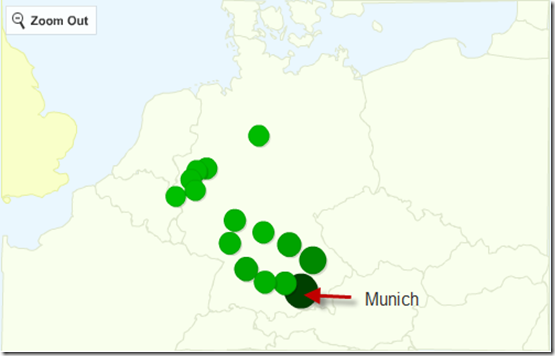
The spatial landscape in Germany is of great interest. The popularity of each brand is influenced by the headquarters of the brand. BMW is based in Munich. The internet-based searches from Germany are the highest in Munich for BMW.
image

Similarly,  has its headquarters in Stuttgart. No wonder that the highest searches for Mercedes in Germany are recorded in Stuttgart.

image

Toyota and Honda enjoy popularity in Frankfurt and Ford is most popular in Cologne. 

image

image

Monday, October 12, 2009

Is Facebook ready for the face off in Canada?

The most common search item googled in the past three months Canada is facebook. Youtube is a distant second.

The fact that Canadians are weary of the weather should come as no surprise since ‘weather’ is the third most searched item by Canadians. And yes, notice in the graph below that hotmail is beating Yahoo big time.

Canadians it appears are big on kjiji than eBay, which didn’t make the list.

Lastly, why would one google Google? Apparently many Canadians have?

Thursday, October 8, 2009

Rail link between Union Station and Pearson airport in Toronto

I find it odd that a few years after making the tall claim that the rail link will be financed and operated by the private consortium, the Federal Government and Ontario are now going to subsidize the winning bidder of the three by a billion dollars! See Globe's coverage.

image

Friday, October 2, 2009

A BRIC smashes through the American dreams to host Olympics

The Olympics Committee has awarded the 2016 Olympics to Rio De Janeiro. This must have shocked the other three 1st world cities namely Chicago, Madrid, and Tokyo, who were also vying for the same. While the Brazilians are busy celebrating on the beaches in Rio De Janeiro, it appears that a BRIC has smashed through the Olympic dreams of the other three major first-world metropolis.

Given the sense of entitlement, many in Chicago, Madrid, and Tokyo are simply shocked at the outcome where their modern first-world economies have been beaten by an emerging BRIC economy. The decision by the Olympics Committee is in recognition of the changing times where all those who felt entitled should now be able and willing to earn their entitlements.

Also, given the sharp increase in the fading hospitality of many western countries, which now routinely refuse entry to academics and athletes, one should think twice of hosting any major international event in Europe or North America. Consider that the British government refused permission to the Pakistani blind cricket team, who happens to be the world's champion in blind cricket, to visit United Kingdom to play in a tournament. It was only a few years ago that a young academic from India, Manindra Agrawal, was refused entry to the US where he was to be recognized by other leading mathematicians for his breakthrough. It took extensive lobbying by the leading mathematicians in the United States to have the decision overturned. Imagine doing the same for thousands of athletes and other sports staff that accompany every Olympics.

I am no fan of the Olympics, but I feel that this decision is good for the sports and athletes around the world. Also, there's no place on the planet like Rio.

Tuesday, September 8, 2009

Krugman on how Economists got it wrong

Paul Krugman has done it again. He has used the popular press to explain the intricacies of the modern day economic thought. In his op-ed contribution to The New York Times Paul Krugman explain what s wrong with the mainstream economic thought. Paul Krugman writing in the New York Times on Sunday offers a succinct review of the contemporary economic thought and the motivations behind it.

Krugman does not shy away from finding faults with the works of his contemporaries including Milton Freidman, Eugene Fama and Robert Lucas, while at the same time offering praise for Robert Schiller and Rughuram Rajan.

This article will most likely be debated for years as it has exposed the differences in opinion amongst the economists in a language accessible to an average newspaper reader. I, for one, has benefitted tremendously from this article. I hope you will find it informative as well.